
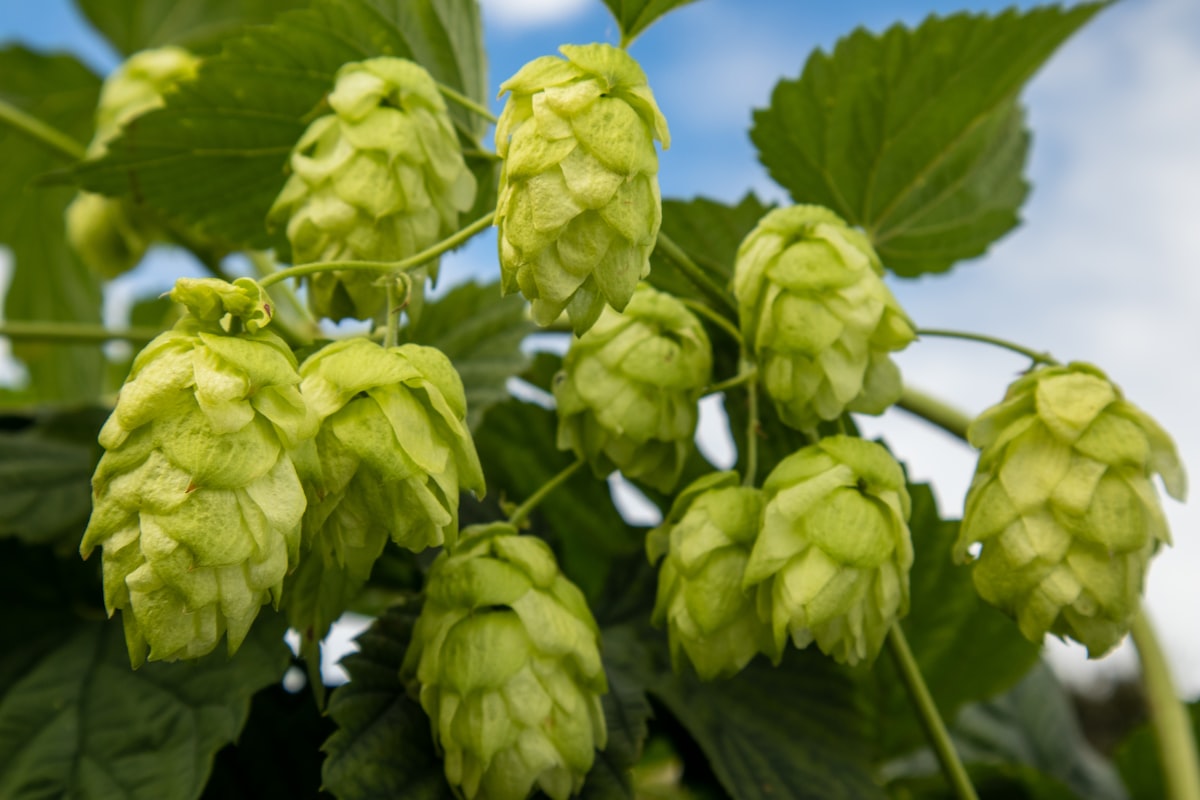
- Hops extract may lengthen sleep duration in animals.
- The evidence score is 5, and reliability is very limited.
- This information is for people interested in research on sleep-related ingredients.
Hops is a plant in the alder family (Humulus lupulus L.).
It is commonly used in contexts such as beer brewing.
The research examines an extract from the plant called Humulus lupulus L. (hops). This extract has been shown to contain components such as xanthohumol and humulone.
Regarding how these components act on the body, based on the current data it is thought that they may work via the GABAA receptor (a receptor involved in neurotransmission in the brain). In other words, there may be a mechanism by which acting on a specific receptor influences the sleep process. However, these are only findings from animal experiments, and the detailed mechanism in humans has not yet been clarified.
It has been suggested that taking hops extract may lengthen sleep duration. In the research, a tendency was observed in which sleep duration became longer as the administered dose increased.
This change has been reported as dose-dependent (the response varies according to the administered amount). In other words, under the conditions of this experiment, the higher the intake, the more strongly the effect on sleep appeared. However, this is only an observation made under specific conditions.
This finding comes from a study of animals placed in a barbiturate-induced sleep state (a model that uses a drug to induce sleep). In the experiment, doses of 100 mg/kg and 200 mg/kg of the extract were administered over a period of 3 weeks.
This study's design is based on an animal experiment (a method of examining effects using animals rather than humans). In technical terms, the verification was carried out using models involving animals such as mice or rats. Because this is not a clinical trial in humans (a trial that confirms the effects of a drug or similar in humans), the effect in humans is not yet known at this time.
The evidence score here is 5, and reliability is very limited. This stems from the fact that only one study has been reported, and that it is still at the animal-experiment stage. As scientific knowledge, this can be said to be an early stage that still needs to be built upon.
The research has limitations, and the testing was not conducted under the same environment or conditions as humans. Therefore, this result cannot be directly applied to human sleep as is. Some people may experience an effect while others may not, so caution is needed. It is hoped that more reliable information will accumulate through future research.
| Study | Design | Number of Participants | Duration | Main Result |
|---|---|---|---|---|
| Journal of Ethnopharmacology (2025, PMID:39522843) | Animal experiment | Unknown | 3 days | A positive effect was reported |
This research was conducted on a barbiturate-induced sleep model (animals such as mice/rats).
Because this is research using an animal model, its direct applicability to humans should be treated only as a point for consideration.
This report is based on an animal experiment.
There is only 1 study, and reliability is reported to be very limited.
Caution is also needed because this is research conducted under specific conditions using barbiturate.
What effect is hops reported to have on sleep?
In animal experiments, administering an extract containing hops components confirmed a change in sleep duration. The result was that sleep duration became longer according to the dose administered.
Has research on hops also been conducted in humans?
This report is based on animal experiments using mice and rats. Therefore, the effect in humans is at a stage that still needs to be examined.
What dose of hops extract was used?
The study used doses of 100 mg/kg and 200 mg/kg. The administration period was 3 weeks.
Hops extract has been suggested to potentially lengthen sleep duration in animal experiments. However, this data comes from a single study, and reliability is very limited. Much remains unknown about the effect on humans, so rather than taking this information at face value, let's keep an eye on future research.
Please also try the self-check assessment to learn about your own sleep condition.